Plan a practical halal meal-prep week in New York with shopping, verification, nutrition, budgeting, storage, and food-safety guidance.
What this guide covers
- 01Plan only the meals your real calendar leaves open.
- 02Verify halal claims before buying ingredients for a full batch.
- 03Build flexible components instead of seven unrelated recipes.
- 04Use one primary grocery stop and one trusted halal source.
- 05Cool, label, refrigerate, and reheat food within USDA guidance.
- 06Treat cost and nutrition totals as transparent estimates.
Plan the week you actually have
The fastest way to make meal prep feel impossible is to plan for an imaginary week. Start with your calendar. Mark the evenings you will eat out, the lunches already covered by work or school, and the nights when cooking from scratch is realistic. Then count the meals that are genuinely unclaimed. That number—not a perfect seven-day grid—is your starting point.
New York adds its own friction: groceries may come home on the subway, refrigerator space may be limited, and a Sunday afternoon can disappear into errands. A plan that respects those limits will usually last longer than one built around an influencer’s refrigerator. USDA’s MyPlate planning guidance makes the same practical point: check what you already have, think about your time, plan for leftovers, and mix fresh, frozen, and shelf-stable foods [2].
For a first week, prepare three to five meals rather than every bite you expect to eat. One dependable lunch, one flexible dinner base, and two ready-to-grab snacks can remove a surprising amount of weekday stress. Leave open space for a family dinner, a late meeting, or the neighborhood place you genuinely enjoy. Flexibility is not a failure of the system; it is what makes the system usable.
Choose a prep horizon, not a forever routine
Ask one question before choosing recipes: “How many days am I willing to eat this?” A three-day plan can stay entirely in the refrigerator. A five-day plan usually works better when later portions are frozen soon after cooking and moved to the refrigerator when needed.
Repeat only the parts that save effort. You might cook one pot of rice and roast two trays of vegetables, then change the protein, sauce, herbs, or crunchy topping. The goal is useful repetition—not identical boxes lined up for a photograph.
Verify halal before it becomes a batch
Halal meal prep begins before the stove turns on. If a meat, sauce, stock, cheese, flavoring, or prepared ingredient does not meet your household’s standard, cooking six portions only multiplies the problem. Keep the packaging until the meal is assembled so the producer, ingredient list, certification mark, and lot information remain available.
New York gives consumers a useful transparency tool. Businesses and certifiers representing food as halal may be required to register with the New York State Department of Agriculture and Markets, and covered food establishments must post a halal registration form where customers can see it [1]. The state also publishes registration information. That record can help you identify who is making or certifying the claim, but it does not choose a religious standard for you.
Certification practices differ, and sincere Muslim households do not all make the same choices about slaughter methods, shared equipment, enzymes, gelatin, alcohol-derived flavor carriers, or restaurant kitchens. Our role is not to settle those questions. It is to help you collect clear information so you can follow the standard you trust.
Ingredient and allergen labels answer a different set of questions. FDA rules require major food allergens to be identified on covered packaged foods, but an ingredient list is not the same thing as halal certification [5]. Read both the ingredients and the halal verification information; neither should be used as a substitute for the other.
A five-question verification routine
When a label, butcher counter, restaurant, or caterer is unfamiliar, use a short routine. Ask calmly, record the answer if you expect to buy again, and recheck when packaging or suppliers change.
- Who certifies or verifies the product or establishment as halal?
- Does the claim cover the entire product, or only the meat ingredient?
- Are halal and non-halal foods prepared, stored, or cooked on shared equipment?
- Can the business show its current registration or certification information?
- Does the answer match the standard followed in your household?
Build flexible meals instead of seven separate recipes
A useful meal-prep week is usually built from components, not seven unrelated recipes. Choose one or two protein options, one satisfying carbohydrate, two vegetables, and one or two strong flavor elements. Cook them in a sequence that shares equipment: vegetables first, then a tray-baked protein, while rice, bulgur, quinoa, or lentils cook on the stove.
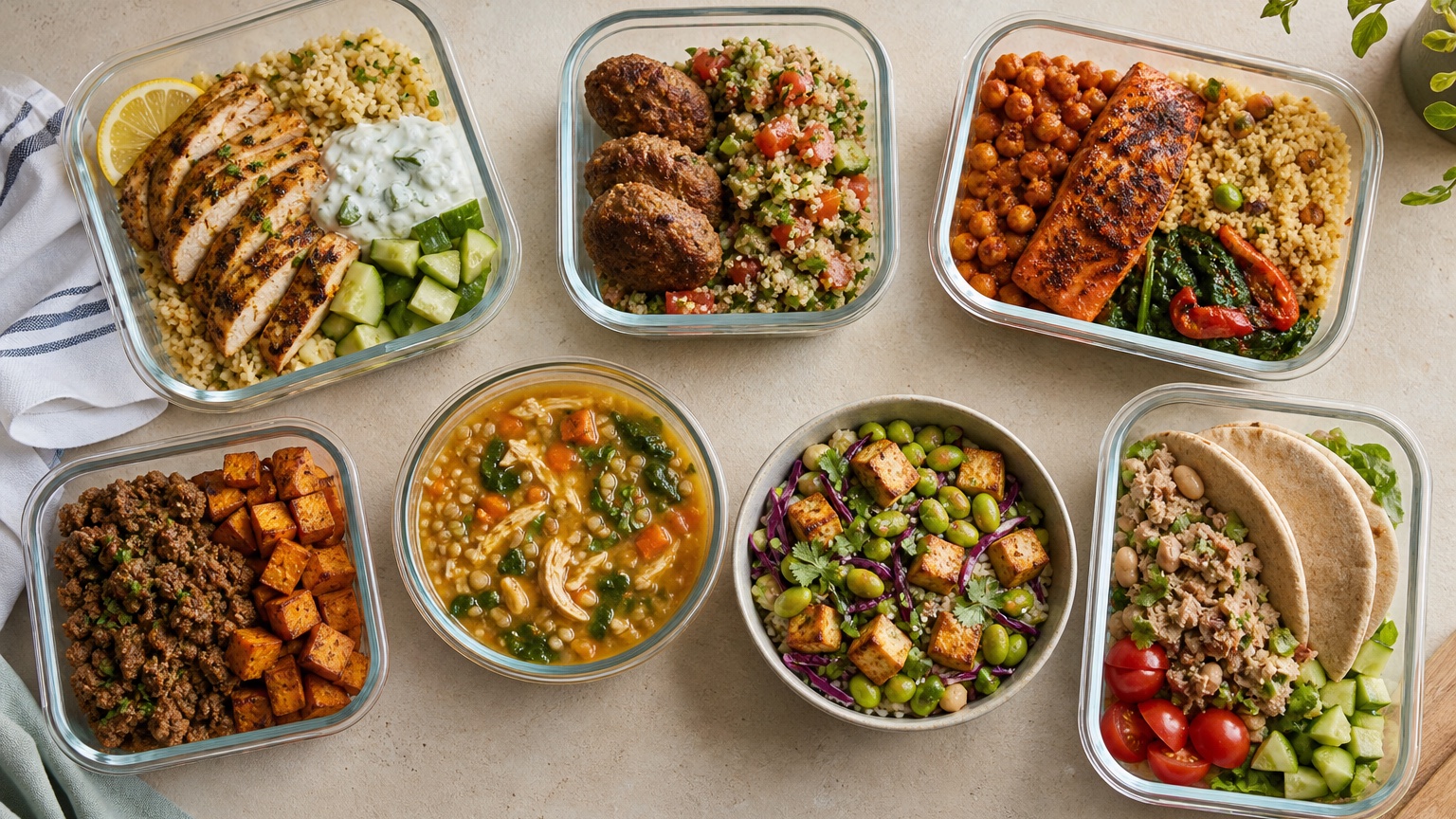
Think in combinations. Lemon-herb chicken, roasted peppers, rice, and yogurt sauce can become a bowl on Monday and a wrap on Wednesday. Spiced chickpeas can join the same vegetables for a meatless lunch. A cucumber salad stays fresher when packed separately. This approach creates variety without doubling the shopping list or covering every counter in the kitchen.
Season the base well, but let sauces and finishing ingredients carry some of the personality. Harissa, tahini-lemon sauce, chimichurri, pickled onions, toasted seeds, fresh herbs, and a squeeze of citrus can make the same cooked components feel different. Store wet, crisp, and hot-to-be-reheated ingredients separately when texture matters.
Use a plate framework without pretending everyone needs the same portions
A simple framework is more helpful than a rigid formula: include a protein food, vegetables or fruit, a carbohydrate source, and enough fat or sauce to make the meal satisfying. Rotate familiar protein foods—including meat, poultry, seafood, eggs, beans, peas, lentils, nuts, seeds, and soy foods—rather than forcing every week into the same chicken-and-rice template.
Portion needs change with body size, age, activity, appetite, pregnancy, health conditions, and personal goals. Begin with a reasonable serving, notice hunger and energy, and adjust the next batch. If you manage diabetes, kidney disease, a serious allergy, pregnancy-related needs, or another therapeutic diet, use a qualified healthcare professional for individualized advice.
Shop New York with a two-stop rule
A bargain stops being a bargain when it requires three train transfers and an exhausted takeout order on the way home. For most weeks, choose one primary store for produce and pantry staples and one trusted halal source for meat or specialty ingredients. Save the cross-borough shopping expedition for a planned stock-up day.
Write the list in the order you walk through the store. Buy only the fresh produce you can realistically prep, then use frozen vegetables, canned beans, lentils, tomatoes, and shelf-stable grains to provide backup. Frozen spinach in the freezer is more useful than fresh spinach forgotten behind a takeout container.
Compare unit prices, but compare usable food too. Boneless chicken may cost more per pound yet require less trimming. A large bunch of herbs may be economical if it appears in a marinade, a sauce, and a salad; otherwise the smaller package may be the better buy. Record the prices you actually paid in our meal cost calculator rather than relying on a static citywide estimate.
Cook once, cool quickly, and label everything
Meal prep is a food-storage project as much as a cooking project. Keep raw meat away from ready-to-eat foods, wash hands and work surfaces, and use a food thermometer rather than color alone to judge doneness. USDA’s current consumer guidance lists 165°F for poultry, 160°F for ground beef and lamb, and 145°F followed by a three-minute rest for whole cuts of beef and lamb [4].
After cooking, portion large batches into shallow containers so they cool more quickly. USDA advises refrigerating perishable leftovers within two hours—one hour when the temperature is above 90°F—and keeping the refrigerator at 40°F or below [3]. Do not leave a deep stockpot on the counter for the evening while you wait for it to become completely cold.
Label each container with the food and preparation date. Most cooked leftovers are intended for three to four refrigerated days; freeze portions you will not reach in that window [3]. When reheating leftovers, bring them to 165°F and check more than one spot in dense or microwave-heated food. These numbers are not decoration for the article—they are the safety backbone of a meal-prep routine.
The food-safety numbers worth remembering
You do not need to memorize an entire food code. Keep a small thermometer in the kitchen and remember the few limits that repeatedly matter at home [3][4].
- 40°F or below: refrigerator temperature
- 2 hours: refrigerate perishable cooked food within this window
- 1 hour: the limit when food is exposed to temperatures above 90°F
- 3–4 days: typical refrigerator window for cooked leftovers
- 165°F: poultry cooking temperature and leftover reheating temperature
- 160°F: cooking temperature for ground beef and ground lamb
- 145°F plus a 3-minute rest: whole cuts of beef and lamb
Follow a realistic 90-minute prep flow
Speed comes from order, not rushing. Before you begin, clear one work surface, empty the sink, set out containers, and read every recipe once. Start the item with the longest unattended cooking time, such as a grain or sheet pan. While it cooks, wash and cut vegetables, mix a sauce, and prepare the next protein.
A timer for each active appliance is more reliable than memory. So is a written finish line. If ninety minutes is your limit, stop at ninety minutes with four useful components rather than pushing toward twelve perfect boxes and resenting the kitchen.
- 0–10 minutes: wash hands, clear space, preheat, start grains or legumes
- 10–30 minutes: cut vegetables, mix marinade or seasoning, begin roasting
- 30–55 minutes: cook the protein and prepare one sauce
- 55–70 minutes: check temperatures, finish vegetables, set up shallow containers
- 70–90 minutes: portion, label, cool safely, and clean the work area
Keep cost and nutrition estimates honest
Grocery prices in New York change too quickly for a timeless article to promise one universal cost per serving. Use the amount paid today, the package quantity, and the amount used in the recipe. Include the expensive ingredients people often forget—oil, sauces, spices, garnishes, and disposable packaging—then divide the complete recipe cost by the number of portions you will actually eat.
Nutrition estimates also have limits. For a packaged ingredient, the current Nutrition Facts label is usually the most relevant starting point. For basic foods, USDA FoodData Central is a comprehensive public source, but its entries come from different data types and food samples, so similar-looking items may not have identical values [6]. Raw and cooked weights, drained canned foods, added oil, and changing portion sizes can all shift the result.
Use calorie and protein calculations as planning estimates, not laboratory measurements. Our protein and portion calculator is designed around that principle: enter the product label when you have it, use a general database value when you do not, and show readers the assumptions. Honest approximation builds more trust than a falsely precise number.
Start with this simple New York week
If you are still staring at an empty notes app, begin here: prepare four lunch portions, freeze the fourth if you will not eat it within the recommended refrigerator window, and keep two flexible dinner components ready. Add fruit, yogurt, nuts, hummus, or another verified snack that fits your household.
For example, roast halal chicken thighs and a tray of peppers, onions, and zucchini; cook rice or bulgur; make a lemon-tahini sauce; and prepare chickpeas as a second protein. Build two chicken bowls, one chickpea bowl, and one freezer portion. Use the remaining components in wraps or alongside eggs later in the week. Adjust quantities for your household, not for the photograph.
After the week, review three things: what you enjoyed, what you threw away, and what you wished had been ready. Keep the successful component, replace the weak one, and make the next plan slightly easier. That small feedback loop is the difference between a one-time cooking marathon and a meal-prep system that belongs in your real life.
Frequently asked questions
How many days of halal meal prep should I make at once?
For a first attempt, prepare three to five meals. USDA guidance says most cooked leftovers can be refrigerated for three to four days, so freeze later portions soon after cooking if your plan extends beyond that window.
Does a halal sign mean every item and cooking surface is halal?
Not necessarily. Ask who verifies the halal claim, what the claim covers, and whether equipment or storage is shared. New York’s halal registration information can help identify the certifier, but each household should apply the religious standard it trusts.
Can halal meal prep include plant-based meals?
Yes. Beans, lentils, chickpeas, tofu, eggs, nuts, and seeds can create useful meal-prep options, subject to your ingredient and cross-contact requirements. A week does not need to rely on one meat at every meal.
How do I keep meal-prep food from becoming repetitive?
Repeat neutral components and vary sauces, herbs, crunchy toppings, wraps, and serving formats. Store dressings and crisp ingredients separately so the same base can become a bowl, salad, or wrap.
Are meal-prep calorie and protein numbers exact?
No. Nutrition labels and USDA data are useful starting points, but brands, raw and cooked weights, draining, added oil, and serving size all affect the result. Treat calculator totals as transparent planning estimates.
Sources and further reading
- Halal Foods RegistrationNew York State Department of Agriculture and MarketsAccessed Jul 27, 2026
- Make a PlanUSDA MyPlateAccessed Jul 27, 2026
- Leftovers and Food SafetyUSDA Food Safety and Inspection ServiceAccessed Jul 27, 2026
- What is a safe internal temperature for cooking meat and poultry?USDA Food Safety and Inspection ServiceAccessed Jul 27, 2026
- Food AllergiesU.S. Food and Drug AdministrationAccessed Jul 27, 2026
- About USDA FoodData CentralUSDA Agricultural Research ServiceAccessed Jul 27, 2026
We review articles for clarity and update them when guidance, products, or local information changes. Always verify current certification and food-safety information with the relevant primary source.
Read our editorial policy →NYHMP Editorial Team
Practical, evidence-aware guidance for healthy halal living in New York.